Write the requirement before the shopping list
Equipment choices become clearer when the requirement is specific. “Carry drinking water between confirmed resupply points” can be evaluated. “Make the vehicle expedition-ready” cannot. Describe the task, the operating conditions, the consequence of failure and the evidence that would demonstrate success. Then compare a modification with simpler alternatives, including changing the route or reducing the load.
Every installed item has a total cost beyond its purchase price. Include brackets, wiring, fasteners, protective housings, consumables and the tools needed to service it. Installed mass may be higher than a product's headline figure. Space matters too: a drawer system that organises tools neatly may make access to an electrical isolator or original vehicle jack more difficult.
Separate necessity from convenience
A remote cold-weather assignment, a supported desert survey and a short trip on maintained tracks have different priorities. Insulation and dependable communications may matter more than external storage in one case. Water capacity may dominate another. Convenience equipment can be worthwhile, but it should be identified honestly so that it does not displace safety-critical capacity or maintenance supplies.
Use a written mission profile to prevent accessory creep. Record occupants, terrain, season, likely resupply intervals and the nearest realistic service support. An item earns its place by addressing that profile. If its main argument is “it might be useful someday,” compare that uncertain benefit with the mass and complexity carried on every journey.
Electrical capacity needs an energy budget
List each electrical load and its expected operating duration. Energy demand is different from peak power: a modest continuous load can consume more energy over a day than a powerful device used briefly. Account for battery chemistry, usable capacity, temperature and charging conditions. A solar panel's nominal rating does not guarantee that output under cloud, shade or an unfavourable mounting angle.
Additional batteries, inverters and chargers need compatible control systems, appropriate circuit protection and secure installations. Cable routing and protection matter in vibration, dust and water exposure. Do not use a general article to size protection devices or improvise a high-current installation. A qualified installer should assess the actual components, vehicle integration and applicable rules.
Definition: redundancy and common-mode failure
Redundancy provides an alternative if one system fails. A common-mode failure affects multiple alternatives at once. Two navigation devices relying on the same power source or map data may offer less independence than their number suggests.
Protection and range create trade-offs
Underbody protection can shield vulnerable components, but its design must preserve cooling, drainage, inspection and service access. A raised air intake does not establish a safe wading depth or make a vehicle waterproof. Water can affect breathers, electrical systems, bearings, the cabin and unseen ground support. Manufacturer water-crossing limits remain conditional, and avoiding the crossing may be the correct decision.
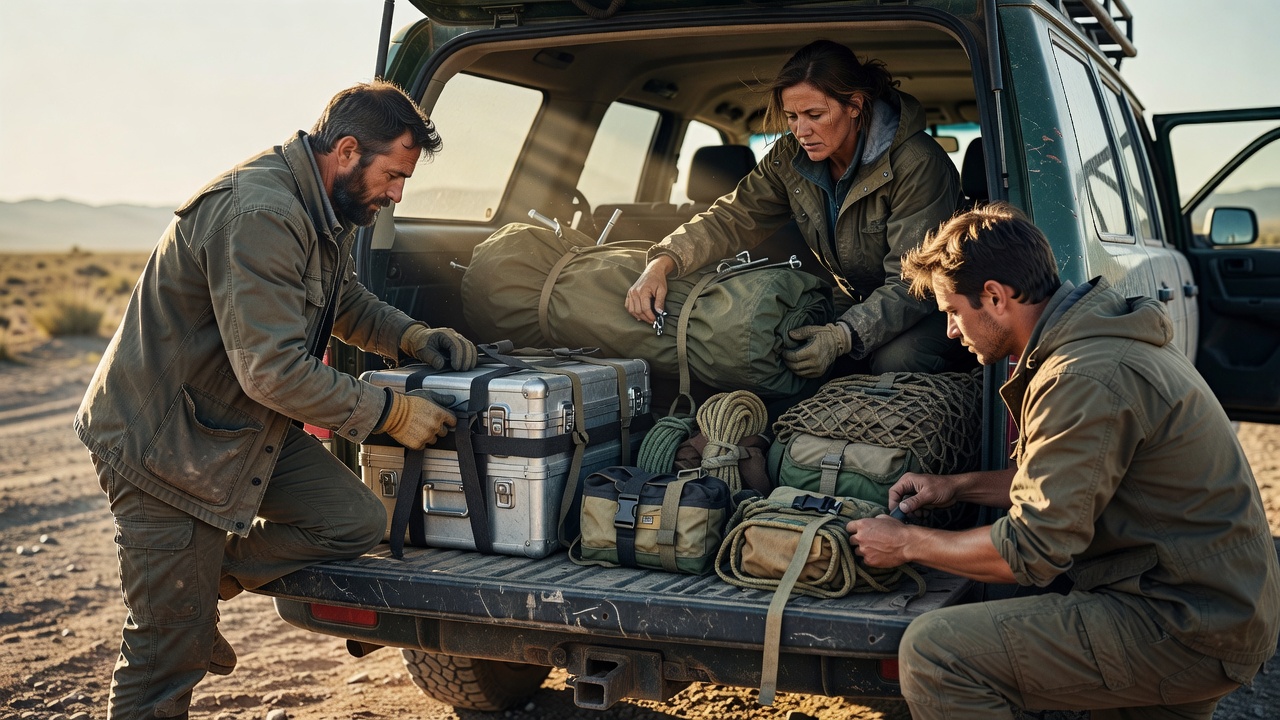
Additional fuel and water increase range but also increase departure mass. Their location changes axle loading and the centre of gravity, while consumption changes that distribution during the trip. Containers and permanent tanks require suitable restraints and compatibility with their contents. More capacity is not automatically better if it removes payload margin or makes safe handling difficult.
The strongest equipment choice is often the one that removes a dependency rather than adding a feature.
Compare on the same basis
| Comparison label | Ask for | Why it matters |
|---|---|---|
| 01 / Installed burden | Complete mass, mounting parts and occupied volume | Catalogue mass may exclude supporting hardware |
| 02 / Compatibility | Exact vehicle fit and documented limitations | A model family can contain materially different variants |
| 03 / Serviceability | Inspection access, replacement parts and repair requirements | Remote downtime can outweigh a small performance advantage |
| 04 / Failure behaviour | What remains usable after failure | A convenience system should not disable an essential one |
Labels need interpretation. IEC 60529 defines the IP Code for enclosure protection, but a stated IP rating is not a general promise of durability under every pressure, chemical, vibration or installation condition. Read the manufacturer's test context and exclusions. Likewise, CE or other conformity markings should not be treated as a ranking of expedition suitability.
Validate the finished arrangement
Before remote use, check the loaded vehicle in a controlled, legal setting. Confirm that essential equipment is reachable, cargo is restrained and routine inspections remain possible. Record maintenance intervals, spare-part identifiers and any installation changes. A modification that works when new but cannot be inspected or supported is not a mature expedition solution.
Revisit the equipment list after each mission. Note what was used, what failed and what created unnecessary work. Keep safety equipment based on credible risk assessment rather than frequency of use alone: some vital items should rarely be needed. The objective is a coherent, maintainable system, not the smallest list or the most impressive vehicle.
Reference starting points
- International Electrotechnical Commission — source organisation for IEC 60529.
- Garmin and Iridium — examples of navigation and communications ecosystems; check coverage, services and local restrictions independently.