Make recovery a route-planning question
The most useful recovery decision may happen before entering difficult ground. Identify where the route narrows, where a vehicle could settle onto its underbody and where a disabled vehicle would block others. Check whether assistance can physically reach the site. Communications coverage, land access and seasonal conditions are part of the plan, not administrative details to add later.
A second vehicle does not automatically provide a safe solution. It may be too light, poorly positioned, similarly immobilised or unable to offer a suitable attachment. A travelling group can share information and support, but it can also multiply exposure if every vehicle follows the same unsuitable line. Decide who can call for outside help and what conditions require the route to be abandoned.
Resistance is not simply vehicle weight
The force needed to move a disabled vehicle depends on more than its mass. Gradient, wheel obstruction, soil deformation, underbody contact and mechanical damage all matter. A vehicle resting on firm ground presents a different problem from one embedded in cohesive mud. Published equipment ratings do not remove the need to assess these conditions.
A winch's advertised line pull refers to specified conditions. Available pull can vary with rope layer, supply condition and equipment design. Electrical demand, thermal duty and mounting structure can constrain the system before a headline rating becomes useful. The relevant documentation is the manufacturer's manual for that exact winch and installation.
Trace dependencies, not just components
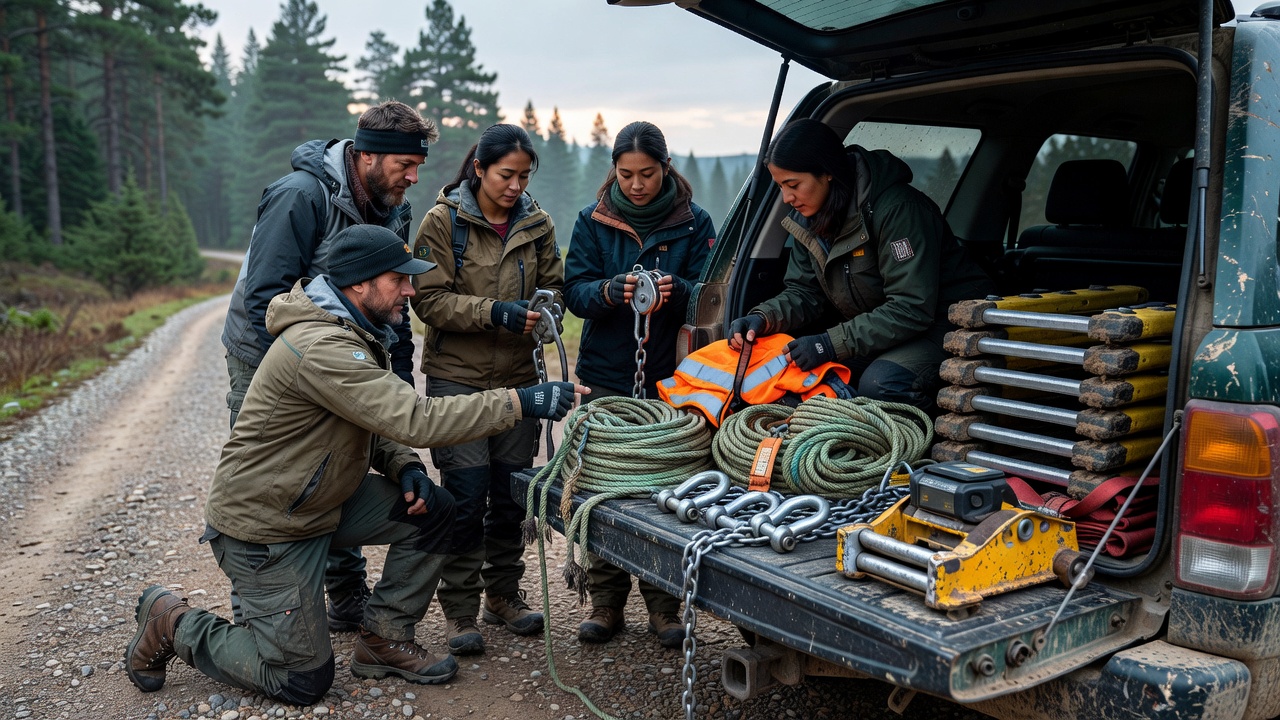
Think of recovery as a load path through multiple structures and connections. Vehicle attachment points, mounting brackets, connectors, line and anchor each require an appropriate intended use and condition. Geometry can change how loads act on components. A strong rope cannot compensate for an unsuitable vehicle attachment or damaged structural mounting.
A transport tie-down point is not automatically a recovery point. A tow ball must not be treated as a recovery attachment. Similarly, a label on a loose connector cannot establish that the connected vehicle structure is suitable. Use vehicle-specific guidance and qualified assessment rather than appearance or an accessory's marketing description.
Definition: working load limit and minimum breaking strength
A working load limit is an allowable load under specified conditions. Minimum breaking strength describes a different threshold and is not an everyday operating allowance. Terminology, test conditions and intended applications must be checked in the manufacturer's documentation; the numbers are not interchangeable.
A recovery kit is a collection of dependencies. It becomes a system only when those dependencies are understood.
Stored energy changes the consequences
Stretched equipment and loaded structures can store energy. If something fails, components can move violently. Synthetic rope is not harmless, and a lighter connector does not make an operation safe. The absence of visible damage does not prove that equipment retains its original strength. Abrasion, contamination, heat, corrosion and previous overload can all be relevant.
Recovery methods also differ. A kinetic recovery involves intentional energy storage and release; it is not equivalent to a controlled winching operation. Equipment intended for one method should not be assumed suitable for another. This site deliberately avoids attachment sequences, force recipes or positioning instructions because safe decisions require the actual scene and competent supervision.
| Dependency | Evidence to seek | Reason to stop |
|---|---|---|
| Vehicle structure | Documented intended attachments and mounting condition | Unknown suitability or deformation |
| Equipment | Readable identification and inspection criteria | Damage, missing history or uncertain compatibility |
| Ground and anchor | Competent assessment of stability and suitability | Uncertain holding capacity or moving ground |
| People and support | Training, communication and external assistance plan | Unclear control or inability to manage exposure |
Plan for the recovery you cannot perform
Self-reliance has a boundary. A mechanical failure, rollover risk, unstable bank or rising water may exceed the capability of the group. Carry the means to communicate location and circumstances, and know how to reach the appropriate local assistance. Do not assume an emergency service provides routine vehicle extraction. Commercial recovery access, cost and timing can be important planning constraints.
Inspection records and retirement criteria are as valuable as additional hardware. Keep manuals available offline and arrange training from a competent provider familiar with your vehicle class. Organisations such as the UK's Health and Safety Executive publish useful principles about work equipment and lifting safety, but the applicability of specific legal duties depends on context. General reading does not replace a site-specific recovery assessment.
Further reference
- Health and Safety Executive: work equipment and machinery — general safety context.
- WARN manufacturer information — locate manuals for the exact equipment; no endorsement implied.