Define the journey before the drivetrain
“All-terrain” is a category label, not a promise. A vehicle that works well on a winter access corridor may be unsuitable for a long road approach, a narrow forest route or a fragile upland surface. Establish the expected ground conditions, loaded mass, route permissions and support arrangements before choosing wheels or tracks. Include the return journey under degraded conditions: weather, fatigue and component wear rarely improve with distance.
Useful comparisons distinguish between mobility and access. Mobility describes the ability to move over a surface. Access also includes legal permission, bridge capacity, trail width, environmental impact and an acceptable recovery plan. A technically passable route may still be inappropriate. Check the relevant land manager rather than treating tyre marks as evidence of permission.
Wheels: efficient transit, concentrated contact
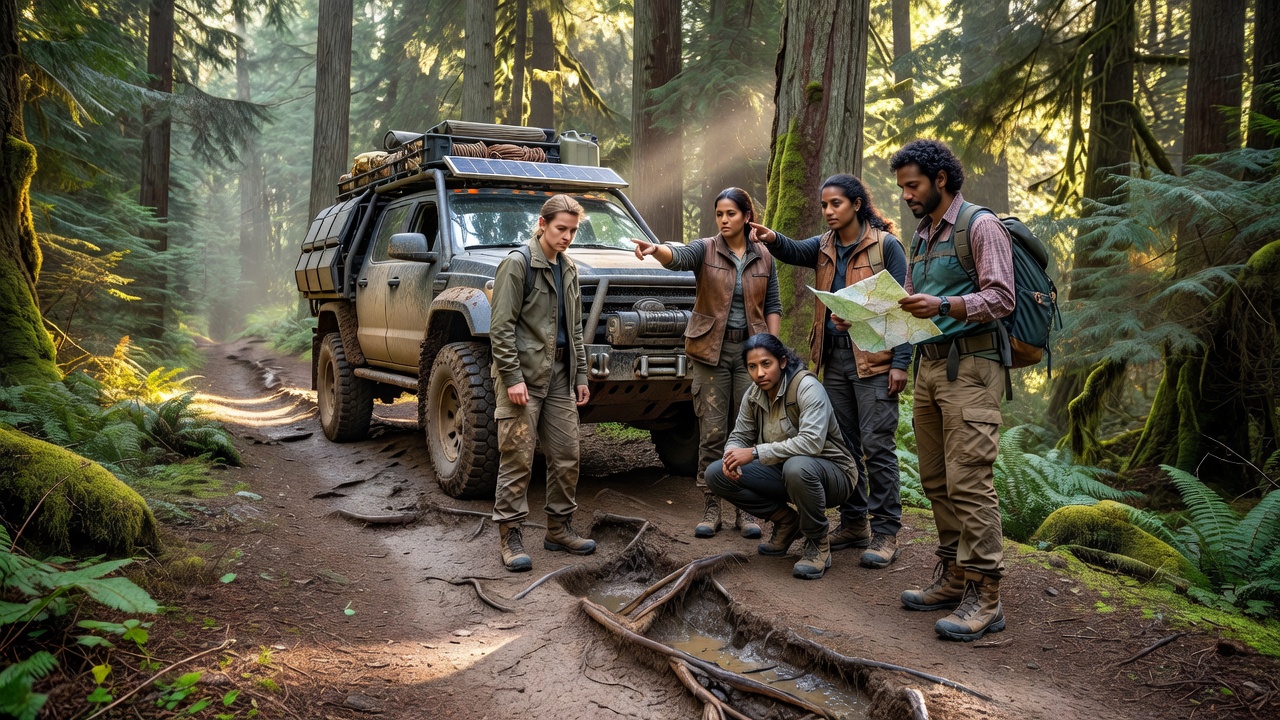
Wheeled vehicles often suit mixed itineraries because road travel, tyre servicing and ordinary workshop access can be comparatively straightforward. A Toyota Land Cruiser, Land Rover Defender or Mercedes-Benz Unimog represents a different vehicle class and operating envelope; the model name alone does not establish payload, dimensions or capability. Compare the exact configuration, market specification and approved equipment.
Tyres create a relatively concentrated ground contact. Their behaviour depends on construction, loading, pressure, tread, temperature and the surface itself. Lower pressure can change the footprint, but it also affects heat generation, bead retention and sidewall damage risk. Use tyre and vehicle guidance for the actual operating conditions. A pressure suitable for one low-speed task may be unsuitable for the next road section.
Definition: traction and flotation
Traction is the usable force transferred between the vehicle and the ground. Flotation describes resistance to sinking through load distribution. More flotation does not automatically provide more steering control or climbing ability.
Tracks: distributed load, additional dependencies
Tracks distribute load over a longer contact region and can reduce nominal ground pressure. This can be valuable on snow, peat or other weak surfaces. However, actual sinkage depends on ground structure, repeated passes, track geometry and changing load distribution. Ground that supports the leading section may fail beneath the rest of the vehicle.
Tracked designs are not interchangeable. An articulated Hägglunds Bv 206 and a skid-steered work machine have different steering arrangements, service needs and load characteristics. Track tension, running gear condition and damage inspection become central maintenance concerns. Turning can disturb vulnerable ground, and a disabled machine may require specialist transport rather than a conventional roadside response.
The best contact patch is the one supported by a workable transport, service and recovery plan.
Compare the complete operating system
| Decision factor | Wheeled platform | Tracked platform |
|---|---|---|
| Mixed road transit | Often more practical; confirm road approval | May require a transporter and loading arrangements |
| Weak ground | Tyre footprint and axle loads are critical | Potential flotation advantage; soil response remains decisive |
| Field maintenance | Tyres and driveline parts vary by model | Track and running-gear support can be specialised |
| Disabled recovery | Weight, access and attachments govern options | Ground engagement and transport can complicate removal |
Payload must be compared in the departure configuration. A larger platform may carry more supplies but demand wider routes, stronger bridges and more fuel. A smaller one can be easier to transport yet leave insufficient capacity after occupants and equipment are included. Neither result is inherently better; the mission decides which compromise is workable.
Turn a shortlist into evidence
Request operating manuals, maintenance schedules, approved loads and transport dimensions before arranging a demonstration. Ask how the machine is recovered when its normal propulsion fails. Identify available workshops and consumables along the intended route. For remote operation, a slightly less specialised platform with known support may offer a stronger overall margin than a machine with outstanding isolated performance.
Terrain also varies by season. Icelandic highland routes can be subject to closures; travel through the Australian Outback depends heavily on local conditions and access advice. These are reminders to obtain current route information, not invitations to assume that a particular vehicle makes the journey acceptable. In protected areas, the route may be unavailable to every platform.
Further reference
- Toyota manufacturer information — use documentation for the exact vehicle.
- Mercedes-Benz Special Trucks — manufacturer context for specialist platforms.
- Icelandic Road and Coastal Administration — current official road information.